
The BJJ Coordination Problem (Why Your Training Feels Like a War of Attrition)
The one mistake that's sabotaging your BJJ progress!

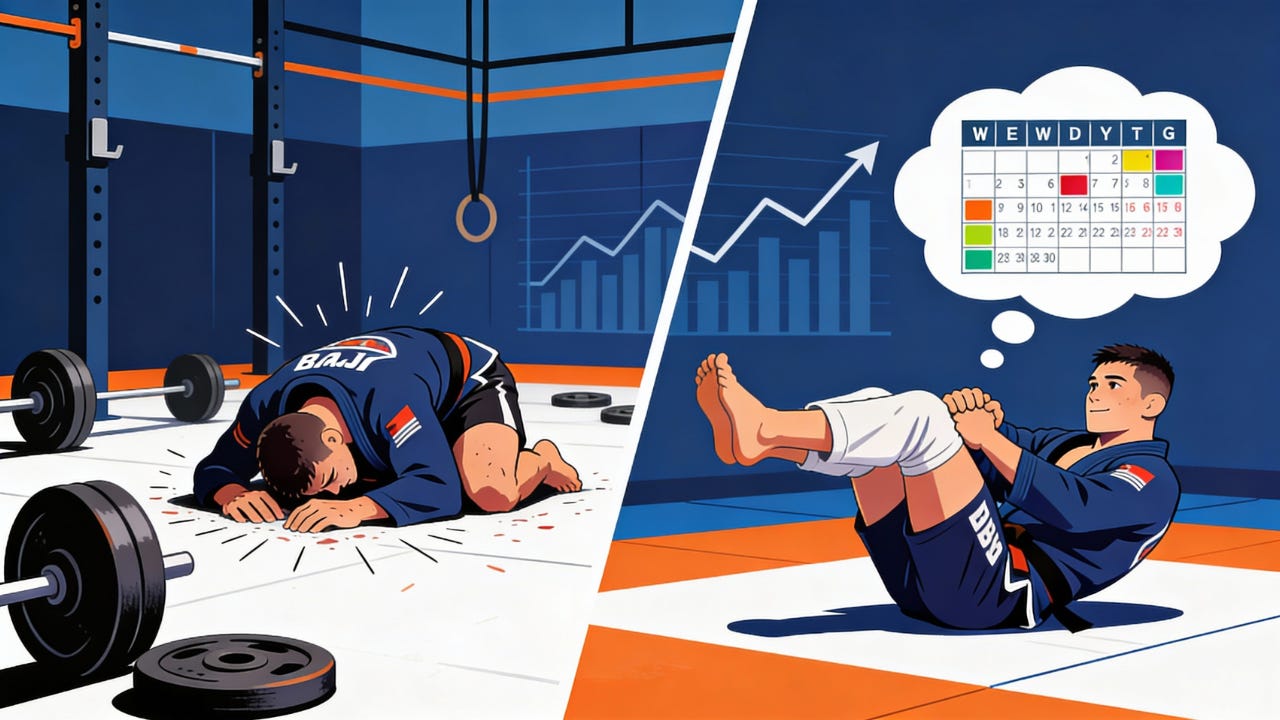
Let me tell you about the worst training week of my life.
It was a Tuesday morning. I dragged myself into the gym at 6 AM, still sore from Monday’s heavy squats. My coach had programmed deadlifts—3 sets of 5 at 85% of my max.
I should’ve been excited. Instead, I felt like I’d been hit by a truck.
By the time I got to evening BJJ class, my legs were cooked. I couldn’t finish a single takedown. My guard retention was non-existent. I got passed, mounted, and submitted by a blue belt half my size who normally I’d give a competitive roll.
I left the mats that night thinking, “Maybe I’m just not cut out for this.”
But here’s the thing—I wasn’t the problem. My training schedule was.
And if you’ve ever felt like you’re working hard but getting nowhere, chances are you’re making the same mistake I was.
The Problem: Your Training is Fighting Against Itself!
Most BJJ athletes approach strength training and mat time like they’re two separate activities. You hit the gym on Monday because you’re motivated. You show up to BJJ on Tuesday because it’s on the schedule. You lift again on Wednesday because, well, that’s what serious athletes do.
But here’s what nobody tells you: Your body doesn’t care about your schedule. It only cares about cumulative fatigue.
When you squat heavy on Monday, you’re not just tired on Monday. Your central nervous system is taxed for 48-72 hours. Your muscles are inflamed. Your glycogen stores are depleted. Your body is in recovery mode.
So when you show up to hard sparring on Tuesday—especially if you’re drilling takedowns or playing a pressure-heavy top game—you’re asking your body to perform at 100% when it’s operating at 60%.
That’s not a training plan. That’s a recipe for:
Plateaus (because you’re never fresh enough to actually improve)
Injuries (because your form breaks down when you’re fatigued)
Burnout (because everything feels harder than it should)
I learned this the hard way. You don’t have to.
The Solution: Coordination, Not Separation
The secret isn’t training more. It’s training smarter.
Your strength work and your BJJ sessions need to talk to each other. They need to be coordinated so that when you’re drilling technique, your body is fresh enough to learn. When you’re lifting heavy, you have the energy to actually push your limits.
Here’s what that looks like in practice:
Monday: Heavy Strength + Light Technique
You squat or deadlift in the morning when you’re fresh.
You do light drilling in the evening—no hard sparring, just reps of your core techniques at 60% intensity.
Your body gets the strength stimulus it needs without frying your CNS for the rest of the week.
Tuesday: BJJ Focus + Conditioning
Your legs are still recovering from Monday’s lifts, so you skip the gym.
You focus on technique drilling in the morning (moderate intensity, 50-60%).
You add a short conditioning circuit in the evening (HIIT, burpees, kettlebell swings) to build your gas tank without destroying your legs.
Wednesday: Active Recovery
Light yoga, mobility work, and flow rolling at 30-40% intensity.
This is the day that saves your training week. It keeps you moving without adding stress.
Thursday: Strength + Power + Competition Simulation
You’re recovered from Monday’s heavy lifts, so you hit another strength session (squats, bench, rows).
In the evening, you do tournament-style rolling at 70-75% intensity.
Because you rested on Wednesday, you actually have the energy to execute your game plan.
See the pattern?
Heavy strength days are paired with light technique days.
Hard sparring days are strategically placed when your body is recovered.
Active recovery is built in, not left to chance.
This is what I call The Coordination Principle: Your training only works when every session supports the next one.
Why This Changes Everything?
Once I started coordinating my training, three things happened almost immediately:
My technique improved faster. Because I was drilling when I was fresh, I could actually focus on the details. My armbar setups got tighter. My guard retention got sharper. I wasn’t just surviving—I was learning.
My strength gains accelerated. Because I wasn’t trying to squat heavy while my CNS was fried from sparring, I could actually push my limits in the gym. My deadlift went up 30 pounds in 8 weeks.
I stopped dreading training. Because I wasn’t constantly sore, tired, and beaten down, I actually looked forward to showing up. Training became fun again.
And here’s the kicker: I wasn’t training more. I was training strategically.
The Framework: 6 Days, Strategically Coordinated
If you want to build strength and improve your BJJ without burning out, you need a system that accounts for cumulative fatigue, recovery, and progression.
That’s exactly what I built into the 7-Day BJJ & Gym Training Checklist.
Here’s how it works:
✅ Monday: Heavy strength (deadlifts, pull-ups, bench press) + light BJJ drilling (60% effort)
✅ Tuesday: BJJ focus (technique drilling + moderate rolling) + conditioning circuit
✅ Wednesday: Active recovery (yoga, mobility, flow rolling at 30-40%)
✅ Thursday: Strength + power (squats, kettlebell swings) + tournament-style sparring (70-75%)
✅ Friday: Heavy lift (your choice: deadlift, squat, or bench) + light rolling (50%)
✅ Saturday: Full-body strength + competition sparring (3 x 6-minute rounds)
✅ Sunday: Complete rest (no training, just recovery)
Every session is timed to maximize your performance on the mat and in the gym. Heavy days when you’re fresh. Light days when you’re recovering. Rest when you need it most.
No more guessing. No more random training. Just a clear, structured plan that coordinates everything.
What Happens When You Stop Fighting Your Own Training?
Here’s what I want you to imagine: It’s Tuesday evening. You walk into class, and instead of feeling like you’ve been hit by a truck, you feel good. Your legs are fresh. Your mind is sharp. You drill your techniques with precision, and when it’s time to roll, you execute your game plan instead of just surviving.
That’s what coordination looks like.
And it doesn’t take more time. It doesn’t require more effort. It just requires a plan that actually accounts for how your body works.
If you’re tired of feeling like you’re working hard but getting nowhere, it’s time to stop training randomly and start training strategically.
👉 Get the 7-Day Training Checklist here and see what happens when your training actually works together instead of against itself.
I’ll be back in your inbox in a couple of days with the second piece of the puzzle: The Recovery Gap (and why most athletes train hard but recover randomly).
Train smart,
Ben
P.S.—The biggest mistake I see athletes make is thinking that if they just train harder, they’ll break through their plateau. But effort without structure is just exhaustion. The 7-Day Checklist gives you the structure. You bring the effort.