
The Progression Framework (Why You Train Hard But Never Get Stronger)
The one thing that separates PRs from plateaus!

Hi, Let me ask you a question: What did you deadlift last Monday? And what did you deadlift the Monday before that?
If you can’t answer that question off the top of your head, I already know why you’re not getting stronger.
It’s not because you’re lazy. It’s not because you’re training wrong. It’s because you’re not tracking progression.
And if you’re not tracking progression, you’re not actually progressing. You’re just showing up, doing stuff, and hoping for the best.
Let me tell you why that doesn’t work—and what to do instead.
The Progression Problem: You’re Training, But You’re Not Building
Here’s what most BJJ athletes do:
Monday: Show up to the gym. Do some deadlifts. Maybe 3 sets of 5. Feel good.
Next Monday: Show up again. Do some deadlifts. Same weight. Same reps. Feel… fine.
The Monday after that: Same thing.
Rinse and repeat for 12 weeks.
And then they wonder why their lifts haven’t moved. Why they’re not getting stronger. Why they’re stuck.
Here’s the truth: Your body doesn’t adapt to random stimulus. It adapts to progressive overload.
That means: If you want to get stronger, you need to do slightly more than you did last time.
More weight. More reps. More volume. Less rest. Something has to increase.
But here’s the problem: Most athletes don’t track anything. They just show up, do what feels right that day, and leave.
And that’s why they plateau after 3 weeks.
What Does Progressive Overload Actually Look Like?
Let me show you how this works in practice.
Let’s say you deadlift 225 pounds for 3 sets of 5 reps on Monday.
Week 1: 225 lbs × 5 reps × 3 sets = 3,375 lbs total volume
Week 2: You add 5-10 lbs → 235 lbs × 5 reps × 3 sets = 3,525 lbs total volume
Week 3: You add another 5-10 lbs → 245 lbs × 5 reps × 3 sets = 3,675 lbs total volume
Week 4: You test your max → 275 lbs × 1 rep
That’s progressive overload. That’s how you build strength.
You’re not training randomly. You’re following a progression.
And here’s the kicker: This isn’t just for strength training. It applies to your BJJ technique too.
If you drill the same armbar setup 10 times this week and 10 times next week, you’re not progressing. You’re just maintaining.
But if you drill it 10 times this week, 15 times next week, and 20 times the week after—and you add resistance each time—you’re building skill.
That’s the difference between training hard and training smart.
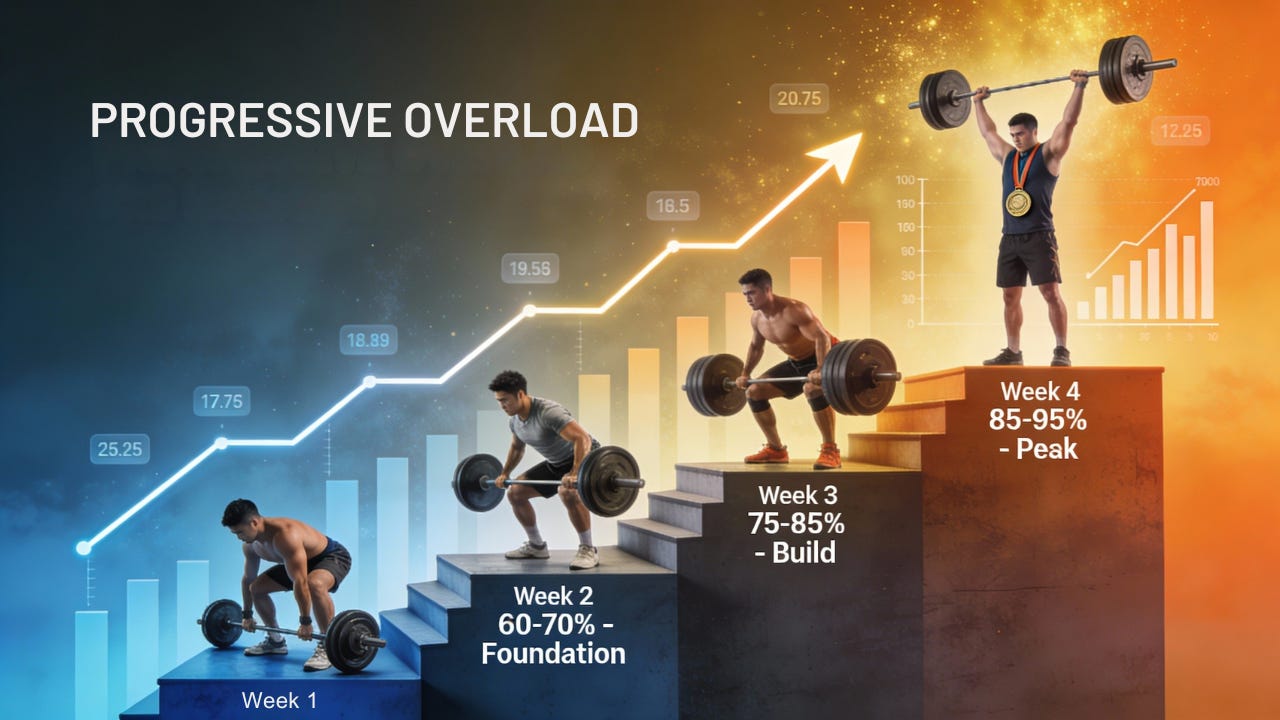
The 4-Week Progression Framework
Here’s the framework I use—and the one I built into the 7-Day BJJ & Gym Training Checklist:
Week 1: Foundation (60-70% Effort)
Focus: Form, consistency, and baseline metrics
Strength: Moderate weight, perfect form, 3 sets × 5 reps
BJJ: Drill 10-15 reps of your core techniques with light resistance
Goal: Establish your baseline. Track everything.
Week 2: Build (70-75% Effort)
Focus: Increase volume slightly
Strength: Add 5-10 lbs to each lift
BJJ: Drill 15-20 reps, add more resistance from your partner
Goal: Push past Week 1’s numbers without overreaching.
Week 3: Push (75-85% Effort)
Focus: Increase intensity
Strength: Add another 5-10 lbs or add an extra set
BJJ: Tournament-style rolling at 70-75% intensity
Goal: This is where the adaptation happens. Push hard.
Week 4: Peak (85-95% Effort)
Focus: Test your progress
Strength: Max out on your main lifts (1-2 reps at 90-95%)
BJJ: Competition simulation (3 × 6-minute rounds at match pace)
Goal: See how far you’ve come. Measure your gains.
Then you repeat the cycle, starting Week 1 at 5-10% higher than last time.
This is how you build sustainable progress. Not random bursts of effort followed by burnout.
Why Most Athletes Never Get Past Week 3
Here’s the pattern I see all the time:
Week 1: High motivation. Crush your workouts. Feel amazing.
Week 2: Still motivated. Adding weight. Feeling strong.
Week 3: Fatigue starts to accumulate. Workouts feel harder. Motivation dips.
Week 4: Either burnout or injury. You take a week off. Lose your progress.
Sound familiar?
The problem isn’t effort. It’s that most athletes don’t have a plan for what happens after Week 3.
They push hard in Weeks 1-2, then either:
Keep pushing at the same intensity (which leads to overtraining)
Back off completely (which leads to losing their gains)
Neither works.
What does work is strategic deload and progression.
Here’s what that looks like in the 7-Day Checklist:
Week 1-2: You build volume and intensity gradually
Week 3: You push hard (this is where the growth happens)
Week 4: You test your maxes and then you reduce volume by 20-30% for recovery
Week 5: You start the next cycle at 5-10% higher than Week 1
This ensures you’re always progressing without burning out.
Tracking: The One Thing That Changes Everything
Here’s the simplest, most powerful tool in your training arsenal:
A notebook. Or a spreadsheet. Or the Weekly Scorecard inside the 7-Day Checklist.
Every week, you track:
✅ Strength Metrics:
Deadlift: Weight × Reps × Sets
Squat: Weight × Reps × Sets
Bench Press: Weight × Reps × Sets
✅ BJJ Technique Progress:
What techniques did you drill this week?
How many reps?
What positions did you practice?
✅ Energy & Recovery:
How did you feel during training? (Low / Normal / High)
Did you hit your nutrition and sleep targets?
Any joint pain or injuries?
That’s it.
When you track your training, you can see your progress. You can identify patterns. You can make adjustments.
When you don’t track, you’re just guessing.
And guessing doesn’t build strength. Structure does.
The Weekly Scorecard: Your Progress Dashboard
Inside the 7-Day Training Checklist, there’s a Weekly Summary Scorecard at the end.
Every Sunday, you fill it out:
📊 Training Completion:
How many days did you train this week?
Which sessions did you complete?
📊 Strength Progress:
What were your lifts this week vs. last week?
Did you add weight? Reps? Volume?
📊 BJJ Technique Progress:
What technique improved the most?
What position needs more work?
📊 Energy & Recovery:
How did you feel overall? (Low / Normal / High)
Did you hit your sleep and nutrition targets?
This takes 5 minutes. And it gives you a complete picture of your progress.
No more wondering if you’re improving. You’ll know.
What Happens When You Follow a Progression Framework
Let me paint you a picture of what the next 4 weeks look like when you follow a structured progression:
Week 1:
You establish your baseline. You deadlift 225 lbs for 3 × 5. You drill 15 reps of your armbar setup. You track everything.
Week 2:
You add 10 lbs to your deadlift. You drill 20 reps of your armbar with more resistance. You’re building momentum.
Week 3:
You deadlift 245 lbs. You roll at match pace and hit your armbar in live sparring. You feel strong.
Week 4:
You test your max: 275 lbs. You compete in a local tournament and win your division. You look back at Week 1 and realize how far you’ve come.
That’s what happens when you follow a progression framework.
You don’t just train hard. You train with purpose.
Your Next Step: Stop Guessing, Start Tracking
Here’s what I want you to do:
This week, track your training.
Write down:
What you lifted (weight, reps, sets)
What techniques you drilled (and how many reps)
How you felt (energy, soreness, recovery)
Then next week, do slightly more.
That’s it. That’s the entire system.
And if you want the full framework—complete with daily workout plans, progression guidelines, and a weekly scorecard to track everything—grab the 7-Day BJJ & Gym Training Checklist here.
It’s everything you need to build sustainable strength and skill over the next 4 weeks (and beyond).
No more guessing. No more random training. Just a clear, structured plan that gets you stronger every single week.
Train with purpose.
Ben
P.S.—The biggest difference between athletes who improve consistently and athletes who plateau? The ones who improve track their progress. The ones who plateau just show up and hope for the best. The 7-Day Checklist gives you the tracking system. You bring the effort.
Brilliant breakdown on why tracking beats effort alone. The point about Week 3 fatigue is dead on, most people dunno whether to push or back off and end up doing neither. I ran into this exact thing last year with squats where I'd plateau, take time off, then lose gains in a loop. The 4-week cycle wit strategic deload solves that way better than just grinding through.